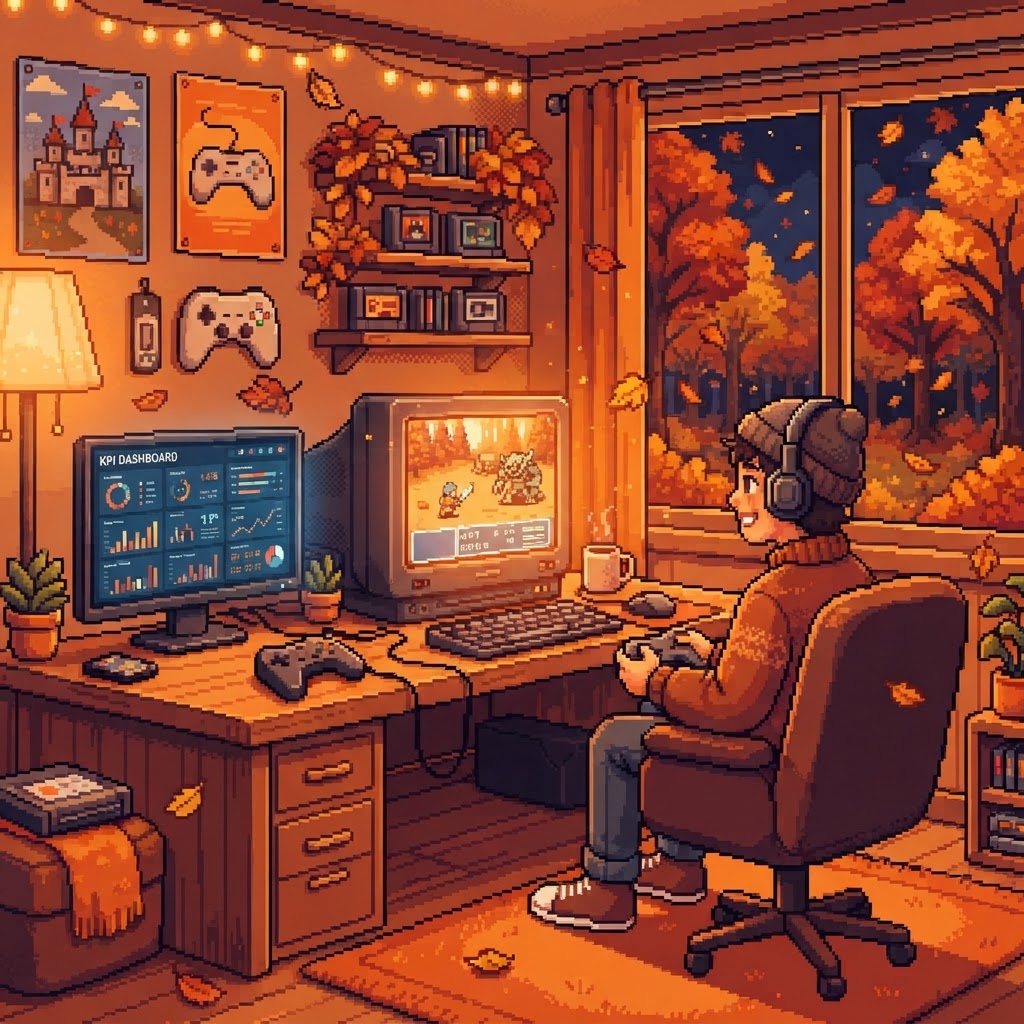
I Watched a CMO Forget Their KPI Dashboard for Six Hours
A marketing director steps away from a KPI dashboard and discovers why live creator participation can outperform passive gaming ad placements. Follow one afternoon of raids, chat momentum, and measurable community action during the Fall in Love with Gaming campaign.
At 1:07 p.m., the marketing director still had three tabs open: the sponsorship dashboard, a spreadsheet of projected reach, and a slide deck comparing cost per completed view across channels.
At 1:12, a creator went live.
By 1:19, the director had stopped looking at the spreadsheet.
This was not part of the original plan. The plan was to observe one stream, take notes, and leave with enough material for an internal recommendation. The campaign, running from September through November 2026, was designed to move a brand into the live rhythm of gaming communities through coordinated streamer raids.
The director expected a media placement. Instead, they walked into a room full of people who already knew one another, had their own jokes, and could tell within seconds whether a brand understood why they were there.
1:07 p.m.: The dashboard looks reassuring
The numbers were familiar: impressions, concurrent viewers, chat rate, clicks, and average watch time. Useful metrics, certainly, but still detached from the experience that produced them.
A dashboard can tell you that 8,400 people are watching. It cannot show you the moment 8,400 people collectively recognize a new creator arriving through a raid, or the split-second decision a moderator makes to welcome them without interrupting the stream’s tone.
That distinction matters if you are evaluating gaming sponsorships. A logo in a static placement can be perfectly visible and completely irrelevant. Visibility is not the same as belonging.
1:24 p.m.: The raid arrives
The first streamer finished a challenge, thanked the community, and sent viewers to another creator participating in the campaign. The transition took less than a minute.
The incoming chat was immediate. Messages appeared too quickly to read individually, but the pattern was clear: greetings, emotes, references to the previous stream, and questions about what would happen next. The receiving creator did not deliver a prepared brand mention. They welcomed the newcomers, explained the challenge, and folded the whole group into the next round.
That is where the sponsorship became real.
The brand was not interrupting the community. It was helping create a reason for the community to move, participate, and stay. The campaign mechanic gave creators room to be themselves, while the shared structure gave viewers a reason to follow the journey.
The director wrote one sentence in the margin of the briefing document: “The audience is not being delivered to us. We are being invited into their afternoon.”
2:10 p.m.: The spreadsheet loses the argument
A message appeared from a viewer asking whether completing the next in-game objective would unlock a donation to a community charity. The answer was yes, within the campaign’s participation rules.
The stream changed instantly. Viewers began coordinating. One person offered a strategy. Another clipped the previous attempt. A moderator pinned the relevant information. The creator adjusted the plan in response to chat.
Nothing about this looked like a traditional ad impression. It was closer to a live group project, with thousands of people contributing attention, humor, skill, and encouragement at the same time.
This is the high-velocity conversion that static reporting often flattens. A viewer sees the challenge, understands the consequence, chooses to participate, and then brings someone else into the moment. The action is social before it is transactional.
For a consumer brand, that creates a more valuable question than “How many people saw the placement?” Ask instead: “What did people do together because the brand made this moment possible?”
3:03 p.m.: The executive starts asking better questions
The director stopped asking whether the stream was on-brand. They started asking whether the brand was useful.
Was the mechanic simple enough to understand in live chat? Could creators adapt it without losing their voice? Did the reward support the community, or merely decorate the broadcast? Were moderators briefed well enough to answer questions without turning the stream into customer service?
These are operational questions, but they are also human ones. Live sponsorships succeed or fail in the details that viewers feel immediately: whether a creator sounds comfortable, whether a giveaway feels fair, and whether the brand respects the community’s time.
The most effective integration was not the largest graphic on screen. It was the campaign rule that gave the audience something meaningful to do together.
4:18 p.m.: The useful report is written afterward
Six hours after opening the dashboard, the director finally returned to it. The numbers had not become less important. They had become easier to interpret.
A spike in concurrent viewers now represented a raid with a visible social purpose. A rise in chat activity reflected coordinated participation, not random noise. A click-through rate could be connected to a creator explaining the action in their own words, at exactly the moment viewers were ready to respond.
That context is the difference between measuring activity and understanding impact.
For sponsorship planning, I would still recommend setting clear targets for reach, retention, conversion, sentiment, and brand lift. But pair those measures with evidence of participation: creator-led explanations, community response, repeat attendance, clips shared after the stream, and the number of viewers who moved from watching to doing.
The best brand sponsorship does not ask a gaming community to pause its culture so an advertisement can appear. It gives creators a reason to make the next moment more engaging, and gives viewers a reason to be part of it.
If you are reviewing gaming partnerships for the autumn, spend one unedited afternoon in the stream, with the dashboard open but muted. Watch what happens when the raid lands, when chat accelerates, and when a creator makes a decision in real time. Then ask your team whether your proposed sponsorship creates that kind of participation, or merely rents the space around it.
I would be glad to compare notes after your next live session, especially if you come away with fewer spreadsheet answers and better questions.
Ready to Join
the Raid?
Streamers earn points & rewards.
Brands get 3 months of real reach.