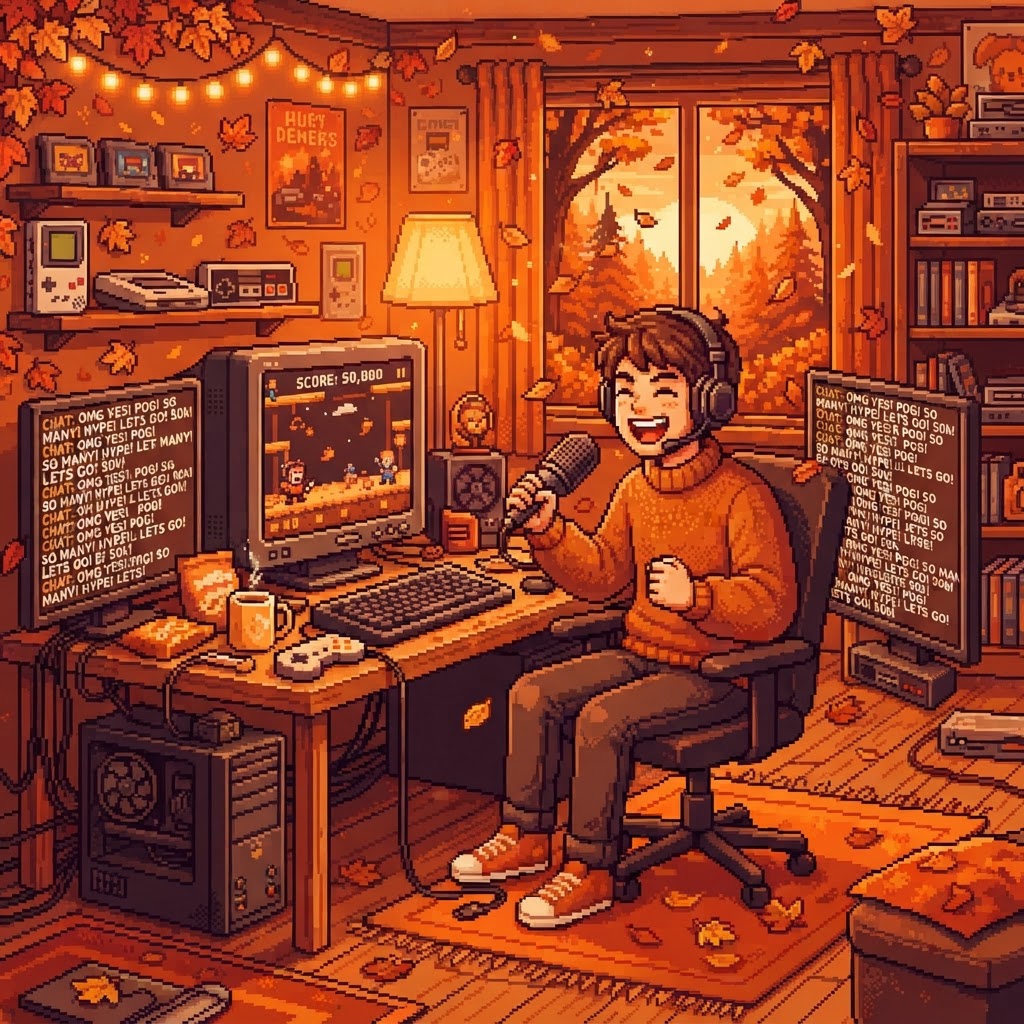
When My Marketing Budget Met 50,000 Live Comments
A brand manager swaps banner dashboards for a 12-hour streamer raid and discovers why live community participation can outperform passive reach. This data-driven case study breaks down the 4x brand-recall lift, the real numbers behind it, and a practical starting point for first-time sponsors.
At 8:00 a.m., my campaign dashboard looked familiar: impressions, viewability, click-through rate, and a reassuringly low cost per thousand. By lunchtime, I was staring at something much less comfortable: 50,000 live comments moving faster than I could read them.
I was the brand manager responsible for a first-time streamer sponsorship during the Fall in Love with Gaming autumn raid campaign. Until that day, I understood audience engagement mainly as a reporting column. A person saw an ad, perhaps clicked it, and became a line in a spreadsheet.
The 12-hour stream changed that model. The audience was not waiting to be marketed to. They were talking, joking, challenging the streamer, reacting to a surprise giveaway, and deciding in real time whether our brand belonged in the conversation.
The result was a 4x higher brand-recall rate than our comparable programmatic banner activity.
The comparison: impressions versus participation
We designed the test around two campaigns promoting the same product and using similar audience targeting.
The first was a standard programmatic display flight running for two weeks:
- 3.2 million served impressions
- 71% viewability
- 0.38% click-through rate
- $8.90 cost per thousand impressions
- 6% aided brand recall in a post-campaign survey
The second was a sponsored streamer activation built around a 12-hour raid. Several creators passed their communities from one channel to the next, with branded prompts, live chat moments, and a simple audience challenge that viewers could join without leaving the stream.
Its topline numbers looked smaller:
- 186,000 live and replay views
- 50,412 live chat comments
- 14,800 unique chat participants
- 9.6 minutes average live exposure per viewer
- 24% aided brand recall in the same survey format
That 24% recall rate was four times the 6% recorded for the banner campaign. The difference was not a cleverer display placement. It was the amount of attention and participation surrounding the message.
What the 12 hours actually felt like
At 10:17 a.m., the streamer mentioned our product during a challenge. The chat immediately split into three groups: people asking practical questions, people making jokes, and longtime viewers explaining the brand to newcomers.
That was the moment I stopped thinking of the activation as an ad placement. The streamer was not reading copy at the audience. They were giving the audience a reason to respond.
Later, one viewer typed, “I only came for the raid, but now I want to try this.” Another asked whether the product worked for a specific use case. The streamer answered in their own voice, and our community manager provided a concise clarification when needed. No scripted interruption was required.
By the end of the day, the brand had appeared in thousands of individual conversations, not just thousands of rendered ad slots.
That distinction matters. A banner asks for a fraction of a second. A live community can spend several minutes discussing, testing, and repeating an idea. The message becomes connected to an experience, a person they trust, and a shared event.
The part that intimidated me
Before the campaign, my biggest concern was losing control. What if the chat moved too quickly? What if someone criticized the product? What if the creator said something we had not approved?
Those concerns were valid, but they pointed to the wrong operating model. Live sponsorship is not about controlling every sentence. It is about preparing for the conversation well enough to participate responsibly.
We built a compact playbook with four elements:
- A clear role for the creator: demonstrate, react, or invite discussion, rather than recite a commercial.
- A short list of non-negotiables: claims, disclosures, prohibited language, and escalation contacts.
- A trained moderation team: two community managers monitored chat, answered factual questions, and flagged issues.
- A measurement plan beyond clicks: recall, sentiment, chat participation, average exposure, and post-stream search lift.
The preparation took three weeks. The live activation was energetic, imperfect, and far more informative than a polished banner report.
What the numbers taught us
The strongest recall did not come from the biggest creator or the most repeated logo mention. It came from moments viewers helped create.
Viewers who participated in chat recalled the brand at a 31% rate. Those who watched but did not chat recorded 18% recall. Passive exposure still had value, but participation added a measurable lift.
We also saw a 22% increase in branded search volume during the raid window compared with the previous four-week average. Direct conversions were modest, at 1,940 tracked visits and 312 purchases, but the more important finding was efficiency of attention. The activation generated 2.1 times more engaged minutes per dollar than the display campaign.
This does not mean banners are useless. They are effective for reach, frequency, retargeting, and consistent delivery. The lesson is narrower and more useful: if your goal is memory, trust, or cultural relevance, impressions alone are a weak proxy.
A practical starting point for first-time sponsors
You do not need to begin with a 12-hour event. Start with one creator whose community matches the audience you want to earn, not simply the largest follower count.
Give that creator a reason for viewers to participate. A live challenge, a useful demonstration, or a community decision will usually outperform a forced product monologue. Agree on the boundaries beforehand, then leave room for the creator’s actual personality.
Finally, measure the conversation. Track unique chatters, repeat mentions, questions answered, sentiment, recall, and the quality of traffic after the stream. Ask not only, “How many people saw us?” Ask, “How many people talked about us, and what did they say?”
I still use banner advertising. I still review impression reports. I simply no longer confuse delivery with connection.
If you have never sponsored a streamer, invite your community, creative team, and measurement lead to watch one live session together. Bring the dashboard, but leave room for the chat. You may find that the most useful marketing data is moving in real time, one human comment at a time.
Ready to Join
the Raid?
Streamers earn points & rewards.
Brands get 3 months of real reach.