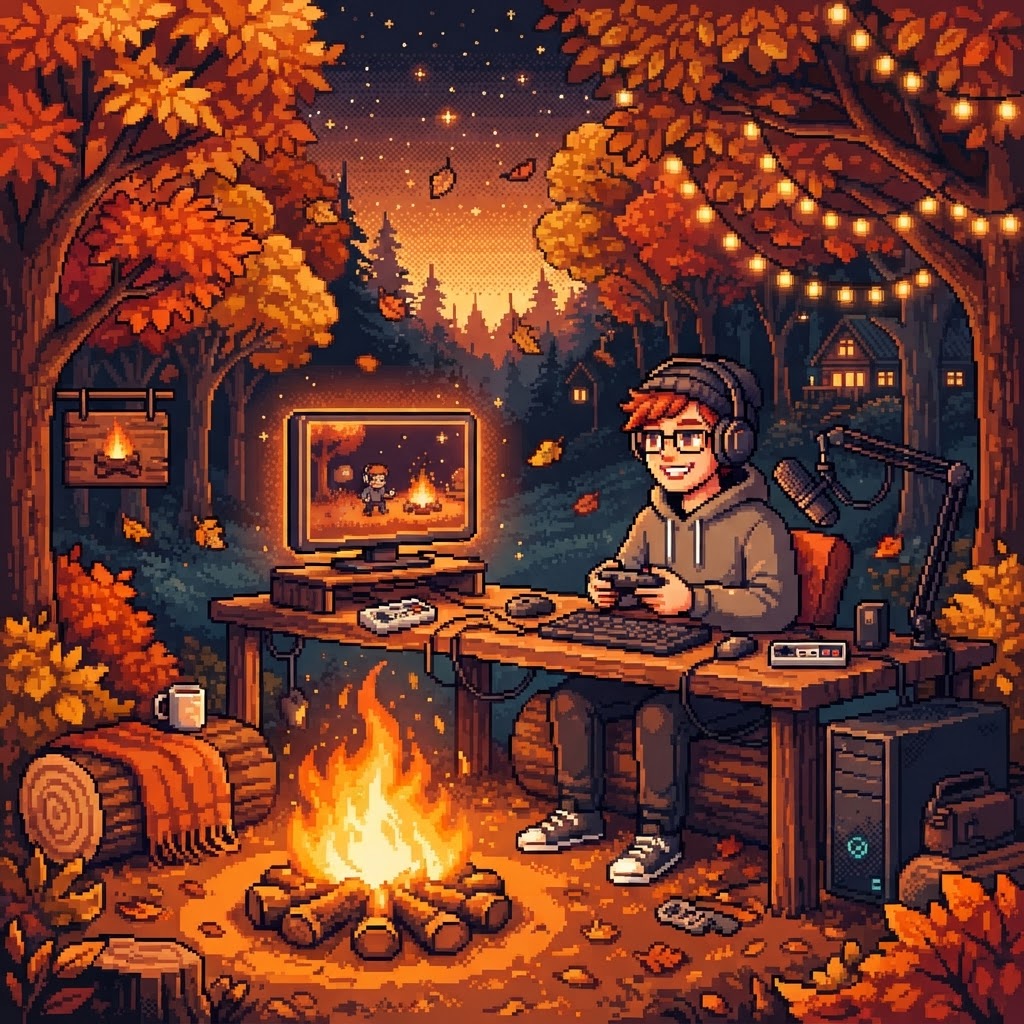
Your Stream Isn't a Billboard, It's a Campfire
Casual streaming does not need to become a sales funnel to matter. This manifesto makes the case for showing up, playing together, and letting genuine community do what polished advertising cannot.
You know the moment. You go live because you have an hour before dinner, a new game to try, or simply the feeling that playing alone would be better with company. Then a campaign lands in your inbox, asking for links, schedules, talking points, and results.
Suddenly, the thing you do for fun starts looking like a spreadsheet.
How many clicks? How many viewers? What was the conversion rate? Did the raid move enough people from one channel to another? Was your audience “activated”?
Those questions are not meaningless. But they are not the heart of streaming, either.
The heart is someone typing, “I needed this tonight.” It is a stranger becoming a regular. It is three people laughing at the same spectacular failure, then deciding to play the game together tomorrow. It is the small, unmeasurable shift from watching a stream to feeling like you have somewhere to be.
That is why the Fall in Love with Gaming campaign matters. Not because it turns your channel into an ad placement, but because it gives you an excuse to do what your channel already does best: bring people into the same room.
Your audience is not a demographic
Traditional advertising looks at people from a distance. It sorts them into age brackets, interests, behaviors, and projected value. A person becomes an impression, a click, or a conversion.
Streaming starts from the opposite direction. You meet people as people.
You know who keeps forgetting to reload. You know who watches quietly during a night shift. You know who will defend an objectively terrible game because it was their first multiplayer obsession. You notice when someone who normally jokes around is having a difficult day.
That knowledge is not targeting data. It is trust, built slowly, in public, through shared time.
A raid can carry that trust from one community to another. When you send your viewers to another streamer, you are not delivering traffic like a courier. You are saying, “These are my people. I think you will like this person.” That recommendation has warmth because it has a face behind it.
No banner can do that.
Stop trying to make the campfire behave like a billboard
A billboard needs to be clear, repeatable, and visible from a distance. A campfire is different. It is uneven. Someone tells a story. Someone interrupts. A spark jumps. The conversation wanders, and somehow everybody stays.
Your stream is a campfire.
It may have ten viewers one night and three the next. The best moment may be a failed speedrun, a bizarre bug, or a conversation that was never on the schedule. The chat may go quiet for twenty minutes, then suddenly erupt because somebody discovers a secret room.
That unpredictability is not a flaw to hide from a campaign. It is the reason people return.
You do not need to manufacture a perfect event. Pick a game you genuinely want to play. Invite your community into the decision. Raid someone whose energy feels right, even if their channel is small. Let the evening unfold. If the funniest moment happens off-script, do not apologize for it. That is the content. More importantly, that is the connection.
The numbers are allowed to be small
Suppose you usually stream for 12 people. During an autumn raid, you send eight viewers to another channel, and five of them stay for ten minutes. One follows. One joins the next stream. Another messages you later to say they had never seen that game before.
A traditional ad report might call that modest performance.
A human being might call it a beginning.
The goal is not to pretend metrics never matter. They can help you understand what your audience enjoys, when people show up, and whether a collaboration is worth repeating. But metrics should describe the community, not replace it. If you spend the whole stream trying to optimize the moment, you may miss the moment itself.
For casual creators, this distinction is everything. You do not need to turn your hobby into a second job to participate. You do not need a studio setup, a polished persona, or a guarantee that the raid will double your follower count. You need curiosity, generosity, and enough confidence to say, “Come see what is happening over here.”
Community beats reach
Reach can introduce someone to a game. Community gives them a reason to stay.
That difference is easy to see in practice. An ad might show a dramatic boss fight in perfect lighting. A streamer shows the boss fight going wrong, then laughs with chat while trying again. The ad presents an experience. The community shares one.
Shared experiences are stickier because they belong to everyone in the room. They create references, rituals, and stories that cannot be copied into a media plan. Months later, people will remember “the night we all got trapped in that dungeon,” not the campaign impression that brought them there.
This is what a raid can protect: the strange, generous, human layer of gaming that advertising often smooths away.
Show up as yourself
So, if you are wondering whether campaigns are worth the effort, ask a better question than, “What will this do for my numbers?” Ask, “Who might I meet if I make room for one more person tonight?”
Then keep it simple. Play something you care about. Tell your audience why you chose it. Welcome the raided community without forcing a performance. Give people permission to lurk, chat, laugh, or leave. Thank the streamer who welcomed you. Let the connection be the point.
This autumn, do not build a billboard and hope people stop walking. Light the campfire you already have, and invite someone closer. Bring your imperfect streams, your small audience, your weird game, and your real voice. The magic is not waiting in a better conversion rate. It is waiting in the next person who sits down to play with you.
Ready to Join
the Raid?
Streamers earn points & rewards.
Brands get 3 months of real reach.