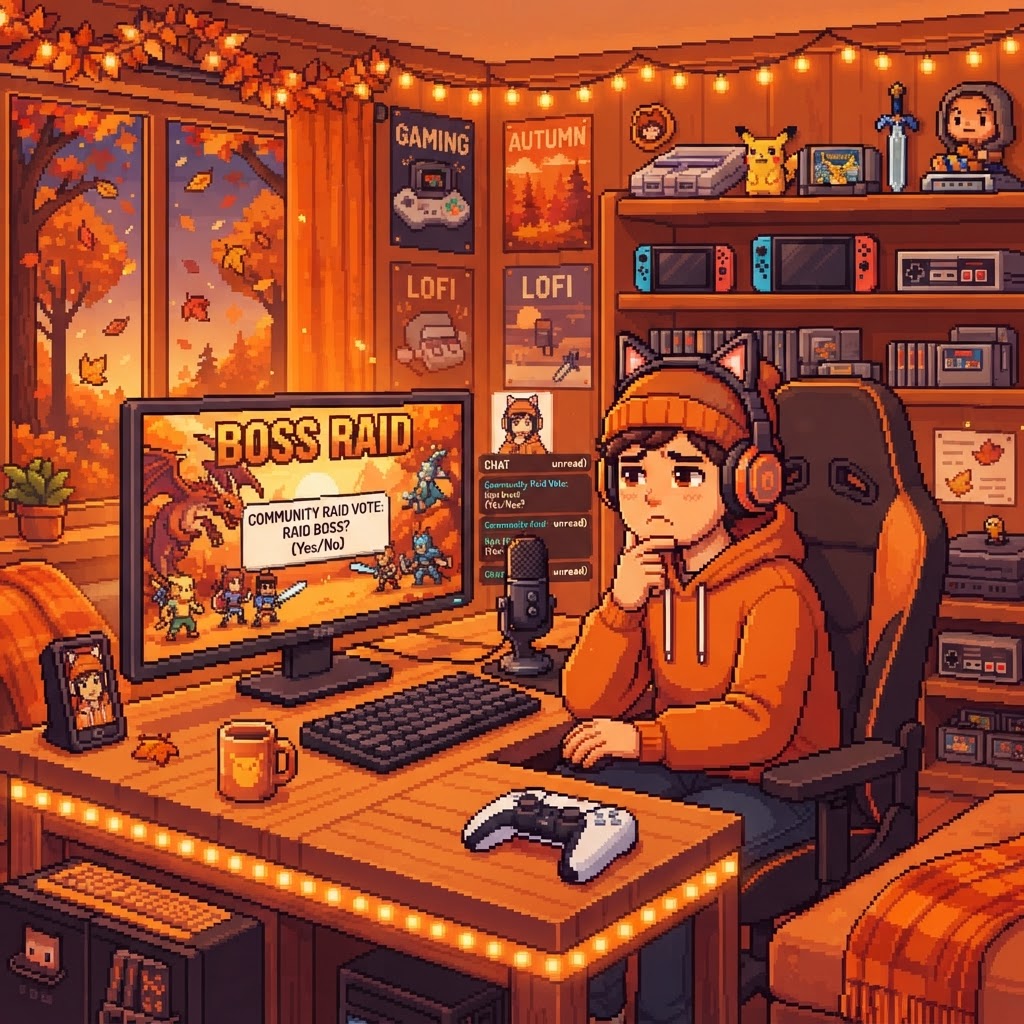
Will My Community Turn on Me If I Say Yes to This Raid?
Worried that a brand deal could change how your chat sees you? This candid Q&A helps you decide whether a raid campaign can fit your stream without asking you to trade away your voice or your community’s trust.
“If I say yes, will my regulars think I sold out?” It’s a fair question, especially when your community can spot a forced read faster than a missed parry. You’ve built trust by showing up as yourself. A sponsorship should not ask you to leave that self off-camera.
Here are the questions worth asking before you join Fall in Love with Gaming, the September to November 2026 streamer raid campaign.
“Isn’t any sponsored stream less authentic?”
Not automatically. Your audience knows you earn a living from your work. The trust-breaking part usually isn’t that money changed hands. It’s when a promotion pretends to be something else, interrupts the stream, or asks you to say things you don’t believe.
A healthier approach treats the brand as a guest star, not the main character. The raid, the game, and your community still lead the experience. Any brand presence should be clear, appropriately disclosed, and built into the event in a way that suits your channel. You should be able to explain the collaboration in your own words, without acting as if a scripted pitch is a spontaneous discovery.
If a campaign asks you to hide the sponsorship or fake enthusiasm, that’s a reason to pause. Transparency is part of being authentic, not an obstacle to it.
“What if my community hates it?”
Some viewers may be skeptical, and you can’t control every reaction. What you can control is how you bring them in. Tell your community what the event is, why you chose it, and what the brand’s role will be. Give them room to ask questions rather than treating every concern as a problem to manage.
Try a simple, specific explanation: “This is a sponsored raid event. I’m taking part because it gives us a chance to visit other channels and make something together. I’ll keep the stream in my usual style, and I’ll be clear about what’s sponsored.” That’s more reassuring than pretending nothing has changed.
For example, if your normal stream has a relaxed, two-hour co-op session, you could make the raid the evening’s shared mission: visit a fellow creator, bring your chat along, and let the conversation and gameplay carry the night. The sponsor is acknowledged, but your viewers still recognize the show they came for.
“Do I have to change my personality or content?”
You shouldn’t have to become a different creator to fit a campaign. Before committing, ask what’s required: Are there talking points? How much airtime is expected? Are there limits on what you can play or say? Can you adapt the format to match your channel?
A good creative collaboration leaves room for your judgment. Maybe your thing is chaotic party games, thoughtful indie reviews, or a chat that votes on every questionable decision. The event should make space for that personality, not sand it away. If the brief feels like a costume you must wear, ask for revisions or decline.
“What if the campaign doesn’t fit my audience?”
A brand name alone doesn’t make something a fit. Think about what your viewers actually enjoy, what they expect from you, and whether the event gives them a real reason to take part. A raid that introduces your community to another creator may feel natural if discovery and shared play are already part of your stream. It may feel less natural if your channel is built around quiet solo play and the format demands constant cross-channel interaction.
You know your audience better than a campaign brief does. Ask how flexible the event is, and be honest about what would work. A thoughtful “not this time” is better for trust than forcing an awkward match.
“Can I still say no?”
Yes. Saying no is not a failure of professionalism, and it doesn’t mean you’re against sponsorships. It means you’re making a decision about this partnership, at this moment, for your channel.
If you’re interested but unsure, ask for the details before deciding. Get the deliverables, schedule, compensation, disclosure expectations, and creative boundaries in writing. Then give yourself time to imagine the stream as your viewers will experience it. Does it sound like a night you’d be proud to host? Can you talk about the partnership plainly? Can you still make the choices that keep your channel yours?
“How do I protect the trust I’ve built?”
Be clear before the stream, not only after someone in chat asks. Keep the sponsored portion easy to identify, make claims only when you can stand behind them, and don’t promise an experience the campaign cannot deliver. During the event, stay present with your viewers instead of turning every moment into a pitch.
Most of all, let your community see your real decision-making. If something feels off, say so privately to the campaign team and ask for a change. If it can’t be changed, you can walk away. Trust grows when people see that your boundaries are real.
Joining a branded campaign doesn’t have to be a sell-out moment. It can be a creative collaboration that gives your community a new kind of night, provided the fit is honest and your voice stays yours. If you’re still on the fence, ask the campaign team the questions you’d want answered as a viewer. And if you do join, tell your community what you’re excited about, what’s sponsored, and what you’ll keep making your own.
Ready to Join
the Raid?
Streamers earn points & rewards.
Brands get 3 months of real reach.